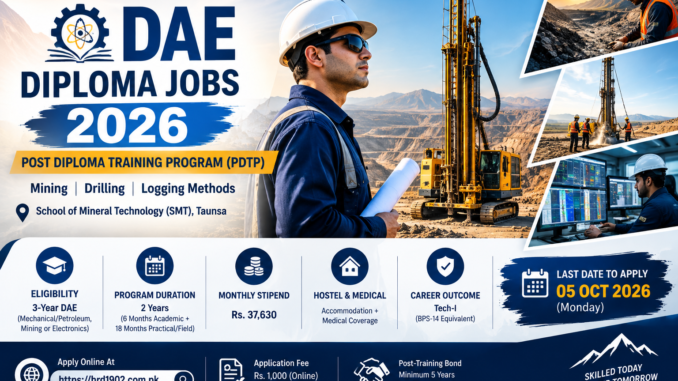
DAE Diploma Jobs 2026 bring a genuinely structured, two-year career pathway for Associate Engineers holding a 3-year DAE qualification. A public sector organization is running a Post Diploma Training Program (PDTP) in Mining, Drilling & Logging Methods, with training conducted at the School of Mineral Technology (SMT), Taunsa, and the program is expected to begin in January 2027. This isn’t a short internship or a loosely defined apprenticeship; it’s a two-year program with a monthly stipend, hostel accommodation, medical coverage, and a defined career track waiting at the end of it.

One honest note before anything else: the advertisement identifies the employer only as “a progressive public sector organization.” It doesn’t name the specific department outright. That said, a few details in this notice point fairly strongly in one direction: the training location, the “Baghal Chur Non Budgetary” account title used for fee deposits, and the mining/drilling/logging technical focus are all consistent with facilities historically associated with Pakistan’s mineral and nuclear-fuel exploration infrastructure in the D.G. Khan region. This is an inference based on these contextual clues, not something the advertisement states directly, so it’s worth verifying the exact organization independently, either through the application portal itself or by contacting the Head Joint Admission Cell listed at the bottom of the notice, before you finalize your decision to apply.
Program Details
| Detail | Information |
| Program Name | Post Diploma Training Program (PDTP) |
| Disciplines | Mining Methods, Drilling Methods, Logging Methods |
| Program Duration | 2 years (6 months academic + 18 months practical/field) |
| Eligibility | 3-year DAE (Mechanical/Petroleum, Mining, or Electronics) |
| Maximum Age | 25 years (as on closing date of advertisement) |
| Apply Online At | https://hrd1902.com.pk |
| Application Fee | Rs. 1,000 (online) / Rs. 1,500 (by post) |
| Submission Deadline | 05 October 2026 (Monday) |
👉 Apply online at hrd1902.com.pk, or by post using the downloadable form. Either way, your complete printed application and paid bank receipt must physically reach the Head Joint Admission Cell, D.G. Khan by 05 October 2026 via courier.
Understanding the Three Technical Disciplines
This program doesn’t offer a single generic training track. It’s structured around three distinct technical disciplines, each tied to a specific DAE background, and understanding which one matches your qualification is the first thing to sort out before you go any further.
Drilling Methods is open to DAE holders in Mechanical or Petroleum technology. Drilling work, as the name suggests, centers on the technical processes and equipment involved in drilling operations, boring into the earth to access mineral or resource deposits, which draws heavily on mechanical engineering principles and, where petroleum-adjacent techniques apply, petroleum technology specifically.
Mining Methods is open to DAE holders specifically in Mining technology. This is the most directly aligned pathway of the three, since your diploma discipline matches the training discipline by name. Mining methods training would reasonably cover the practical techniques of extracting mineral resources from the ground, the operational and safety considerations involved, and the broader methodology of running a mining operation.
Logging Methods is open to DAE holders in Electronics technology. This might seem like an unexpected pairing at first, mining and electronics don’t sound like an obvious combination, but “logging” in a mineral or resource-exploration context typically refers to well logging or geophysical logging, the process of using electronic instruments and sensors to record and measure subsurface conditions, resource characteristics, and geological data. This is inherently an electronics-and-instrumentation-heavy discipline, which is exactly why an Electronics DAE background is the qualifying route here rather than, say, a Civil or Mechanical one.
Across all three disciplines, the underlying qualification standard is the same: a 3-year Diploma of Associate Engineer, in the relevant technology, recognized by the Board of Technical Education, with at least 60% marks. If your diploma falls short of 60%, or comes from an institution not recognized by a Board of Technical Education, you’re not eligible regardless of which of the three disciplines you’re aiming for.
Who Can Apply
Eligibility for this program is built around nationality, academic qualification, age, and a secondary academic threshold that’s easy to overlook if you’re focused only on your diploma marks.
Nationality: The program is open to Pakistani or AJK (Azad Jammu & Kashmir) nationals. This is a slightly broader citizenship criterion than some other public-sector recruitment drives, which sometimes restrict eligibility to Pakistani nationals only, so AJK residents should note they’re explicitly included here.
Academic qualification: As detailed above, you need a 3-year DAE in the specific discipline matching your intended training track (Mechanical/Petroleum for Drilling, Mining for Mining, Electronics for Logging), from an institution recognized by the Board of Technical Education, with a minimum of 60% marks.
Secondary school performance: Here’s the detail that’s easy to miss entirely if you only check your diploma marks: the advertisement also requires at least second (2nd) division in SSC (Matric), meaning not below 50% marks at the secondary school level. This means your eligibility isn’t determined solely by your diploma performance; your Matric result matters too, and a candidate with excellent DAE marks but a Matric result below 50% would not meet this specific requirement. If it’s been a while since you’ve thought about your Matric percentage, it’s worth pulling out that old marksheet and double-checking before you invest time in the rest of the application.
Age: The maximum age limit is 25 years, calculated as of the closing date of the advertisement, meaning 05 October 2026, not the date you actually submit your form if you apply earlier than the deadline.
What You’ll Actually Receive During Training
This is where the program distinguishes itself from a typical unpaid or minimally compensated diploma-holder internship, and it’s worth understanding the full financial picture, not just the headline stipend figure.
Monthly stipend: Selected trainees receive Rs. 37,630 per month throughout the training period. This is a genuine, structured stipend rather than a token allowance, and it’s paid consistently across the two-year program, not just during an initial phase.
Accommodation: Free bachelor hostel accommodation is provided to outstation trainees, meaning those who don’t live locally near the School of Mineral Technology, Taunsa. This is explicitly noted as subject to availability, so if you’re coming from outside the area, it’s worth confirming your accommodation status early in the process rather than assuming a hostel spot is guaranteed simply because you qualify as an outstation trainee.
Medical care: Free indoor medical facility is provided during the training period, covering hospitalization-level medical needs (as opposed to routine outpatient care, which the notice doesn’t specifically address).
Transport: A free pick-and-drop transport facility is provided between your official residence and the work premises, which meaningfully reduces the logistical burden of getting to and from training and field locations during the 18-month practical component especially, when you may be working at sites rather than a single fixed classroom location.
Combined, this package, stipend, accommodation, medical coverage, and transport, represents genuine financial support during a training period, not just a token monthly payment with everything else left for the trainee to arrange and fund independently.
The Service Bond: What You’re Actually Committing To
This is arguably the single most important section of the entire advertisement to understand clearly before you apply, because it’s a binding financial and professional commitment, not a minor administrative formality.
After successfully completing the two-year training program, trainees are bound to serve the Organization for a surety period of at least 5 years, under a prescribed bond. This means your commitment here doesn’t end when your training does; you’re agreeing, in advance, to a minimum five-year employment period with the organization once you’re qualified.
If you refuse to join the Organization after completing training, having accepted the stipend and facilities throughout, you will be required to pay back the incurred expenditures. The advertisement specifies this includes, but isn’t limited to, the full amount of stipend paid during the course of training, plus already waived expenditure (fees or charges that were waived on your behalf during training), all as calculated by the Organization.
This is worth taking seriously before you apply, not after you’ve already accepted a training seat. If you’re not genuinely prepared to commit to at least five years of service with this organization after training, or if you’re applying primarily as a fallback option while hoping for something else to come through in the meantime, this program’s financial structure is built specifically to discourage that kind of approach. The stipend and facilities you receive during training aren’t free in an unconditional sense; they’re an investment the organization expects to recover through your subsequent service, and the bond exists to formalize that expectation with real financial consequences attached if you walk away.
What Training Actually Involves
The two-year program isn’t purely classroom-based. It’s structured as 6 months of academic study followed by 18 months of practical work in the field. This means the majority of your training time, three-quarters of the full two-year period, is spent in hands-on, field-based application rather than in a lecture hall.

This structure has practical implications worth thinking through. If you’re someone who strongly prefers theoretical, classroom-based learning over field-based practical work, it’s worth knowing upfront that this program leans heavily toward the latter. Conversely, if you’re someone who learns best by doing and wants substantial hands-on exposure rather than an extended academic phase, this ratio, 6 months academic to 18 months practical, works strongly in your favor.
Career Outcome After Training
Successful completion of the program isn’t just a certificate with no defined next step. Trainees who complete the program successfully may be appointed anywhere in Pakistan as Tech-I, in a pay scale equivalent to BPS-14, under the CPF (Contributory Provident Fund) scheme.
A few additional details sweeten this career outcome specifically. You receive two advance increments upon appointment, meaning you don’t start at the absolute base of the Tech-I pay scale but a couple of increments ahead of where a fresh appointee without this training would typically begin. You also receive admissible allowances on a regular basis, and importantly, two years of relaxation in your next promotion, meaning your two years spent in structured training count toward reducing the time you’d otherwise need to wait before becoming eligible for your next promotion within the organization.
Worth noting: the word “may” in “successful trainees may be appointed” suggests this isn’t stated as an absolute, automatic guarantee in the advertisement’s own language, though it’s presented as the clear expected outcome for those who complete the program successfully. If this distinction matters to your decision, it’s worth clarifying directly with the organization exactly how appointment works for trainees who complete the program in good standing.
Also worth understanding: “anywhere in Pakistan” means your eventual posting isn’t guaranteed to be at or near Taunsa, or D.G. Khan, or wherever you happen to be from. If geographic flexibility after training is a concern for your personal circumstances, that’s worth factoring into your decision now rather than discovering it as a surprise after you’ve already completed two years of training and accepted the service bond.
How to Apply
You have two application routes, online or by post, but there’s an important detail that applies regardless of which route you choose: your complete printed application must physically reach the Head Joint Admission Cell via courier, no matter how you started the process.
If you apply online, go to https://hrd1902.com.pk and follow the instructions on the website to complete your form. Once you’ve filled out the online application, you still need to upload your paid online bank receipt and a passport-size photograph on the online form itself. But that’s not the end of the online route: you must also send your complete printed application form and paid receipt through urgent courier service to the address given, and this must reach the office by 05 October 2026.
If you apply by post instead, download the Admission Form from the official web portal, fill it out, and send your filled application form and bank receipt through urgent courier service to the same address, again needing to reach the office by 05 October 2026.
In both cases, notice the verb: the application needs to reach the office by the deadline, not simply be postmarked or sent by that date. Given that courier delivery times vary, and D.G. Khan may not be immediately accessible from every part of the country, it’s worth sending your documents well ahead of the actual deadline rather than mailing them on 05 October itself and hoping for the best.
Paying the Application Fee
The application processing fee is non-refundable and differs depending on your chosen route: Rs. 1,000 for online submission, and Rs. 1,500 for applying by post. Either way, the fee must be deposited into NBP account No. PK80NBPA1635003150204120, under the account title “Baghal Chur Non Budgetary AC R 1”, at the BC-1 Branch, D.G. Khan.
Keep your bank receipt safe regardless of which application method you use, since it’s a required upload (for online applicants) or a required physical attachment (for postal applicants), and losing it would mean redoing the payment process.
Keep a Copy of Everything
The advertisement specifically instructs applicants to keep a photocopy of their filled application form and paid bank receipt for personal record, noting plainly that it may be required later on. This is a small instruction, but it’s worth taking seriously; if there’s ever a dispute or a need to confirm your submission details during the selection process, having your own copy on hand saves you from a potentially difficult situation where you can’t easily prove what you originally submitted.
What Happens If Your Application Is Late or Incomplete
The advertisement states plainly, and repeats this point in more than one section, that applications received after the closing date will not be entertained whatsoever, and separately that late or incomplete applications will not be entertained. This isn’t soft language open to case-by-case exceptions; treat 05 October 2026 as an absolute, non-negotiable cutoff for your complete application physically reaching the Head Joint Admission Cell.
If You’re Already Employed in Government or Semi-Government Service
Candidates currently serving in Government, Autonomous, or Semi-Autonomous organizations are required to apply through proper channel. In practice, this typically means securing permission or a No Objection Certificate from your current employer before, or alongside, submitting your application, rather than applying directly and independently the way a private-sector employee or fresh graduate would. If this applies to you, it’s worth starting that internal process early, since obtaining departmental clearance can take longer than the application process itself.
Selection Process
Only short-listed candidates will be called for a written test and interview. The advertisement doesn’t provide further detail on what the written test covers or how shortlisting is determined beyond meeting the basic eligibility criteria, so it’s reasonable to assume that meeting the minimum requirements gets you into consideration, not automatic selection, particularly if the program receives more eligible applicants than it has training seats available.
The advertisement is also direct that candidature can be cancelled at any stage during the process of selection, or subsequently, if it’s found that a candidate doesn’t actually fulfill the prescribed eligibility criteria, and that no claim whatsoever will be acceptable during or after selection if this happens. This underscores the importance of being genuinely certain about your own eligibility, particularly around the SSC second-division requirement and your DAE marks and discipline match, before you invest time and the application fee in this process.
Contact Information and Office Hours
For queries, or to send your postal application, the relevant address is:
Head Joint Admission Cell, PO Box No. 1, Sakhi Sarwar Road, D.G. Khan
Phone: 064-9261221-22
Office hours are Monday to Thursday, 08:30 AM to 02:00 PM, and Friday, 08:30 AM to 12:00 PM. If you need to call with questions about your application or eligibility, plan your call within these windows, since reaching the office outside these hours is unlikely to get you a response.
Is This Program Worth Pursuing? A Few Honest Considerations
Before committing to this application, it’s worth thinking through a few practical realities specific to this program, beyond just the attractive stipend figure.
First, this is a genuinely field-heavy technical career path, mining, drilling, and logging work tends to involve physically demanding conditions, remote or semi-remote site locations, and work that differs substantially from an office-based engineering role. If you’re drawn to this field because of the stipend and structured career path alone, without genuine interest in the technical discipline itself, the 18-month practical field component may prove more challenging to sustain than the classroom portion would have been.
Second, the 5-year service bond is a real commitment with real financial consequences if broken. Don’t treat this as a formality you can walk away from if something more appealing comes along partway through or immediately after training; the advertisement is explicit that walking away means repaying your stipend and waived costs, calculated by the organization itself, which gives you limited negotiating room if that scenario arises.
Third, the “anywhere in Pakistan” posting language after training means you should be personally and logistically prepared for the possibility of relocation, potentially to a mining or resource-exploration site far from your current home area, rather than assuming you’ll remain near Taunsa or D.G. Khan indefinitely.
None of this is meant to discourage a genuinely interested and prepared candidate; a paid, structured two-year training program leading directly into a defined BPS-14-equivalent career, with early increments and promotion relaxation built in, is a strong opportunity for the right candidate. It’s simply worth going in with clear eyes about what you’re committing to, rather than focusing solely on the Rs. 37,630 monthly stipend in isolation.
How This Compares to Other DAE Career Paths
For context, it’s worth understanding roughly where this program sits relative to other options a DAE holder in Pakistan typically considers. Many DAE graduates head toward private-sector technical roles, further education through a B.Tech or equivalent bridging program, or general public-sector technical postings that don’t come with a structured, paid training component attached. What sets this PDTP apart is the combination of a defined, funded training period with a clear, pre-agreed career outcome at the end of it, rather than graduating with a diploma and then independently searching for an employer willing to take a chance on an entry-level technical hire.
The trade-off, as covered above, is the 5-year bond. A private-sector role, or an unbonded public-sector post, generally doesn’t come with anywhere near this level of financial and logistical support during an early-career training period, but it also doesn’t come with a multi-year mandatory service commitment attached. Whether that trade-off works in your favor depends heavily on your own circumstances, how much you value guaranteed structure and support during training versus flexibility to change employers or fields in your first few years after qualifying.
Preparing a Strong Application
Since only shortlisted candidates are called for the written test and interview, and the advertisement doesn’t detail exactly how shortlisting works beyond meeting the baseline eligibility criteria, it’s worth assuming that a complete, carefully prepared application gives you the best possible starting position. Double-check that your DAE certificate and transcript clearly show your discipline and your overall percentage, since a certificate that’s ambiguous about either could create unnecessary friction during review. Similarly, make sure your Matric certificate is on hand and clearly shows your division or percentage, since this is a distinct, separately-checked requirement from your DAE marks.
If you’re applying online, take the extra step of confirming that your uploaded bank receipt is legible and clearly shows the payment details matching the NBP account and title specified in the advertisement, rather than a blurry photo that might raise questions during verification. And regardless of which route you choose, factor in enough time for courier delivery to D.G. Khan; if you’re applying from a distant province, a same-day courier service reaching D.G. Khan within a day or two is a safer bet than a standard postal service with a less predictable delivery timeline.
What disciplines does this training program cover?
Three: Drilling Methods (DAE Mechanical/Petroleum), Mining Methods (DAE Mining), and Logging Methods (DAE Electronics).
What is the minimum DAE marks requirement?
At least 60% marks, in a discipline recognized by the Board of Technical Education.
Do I also need good Matric marks to apply?
Yes. You need at least second division (50% or above) in SSC/Matric, in addition to your DAE qualification.
What is the age limit?
Maximum 25 years, as on the closing date of the advertisement (05 October 2026).
Am I obligated to work for the organization after training?
Yes. You’re bound to serve a minimum of 5 years under a prescribed bond. Refusing to join after training requires repaying the stipend and waived expenses incurred during training.
Leave a Reply