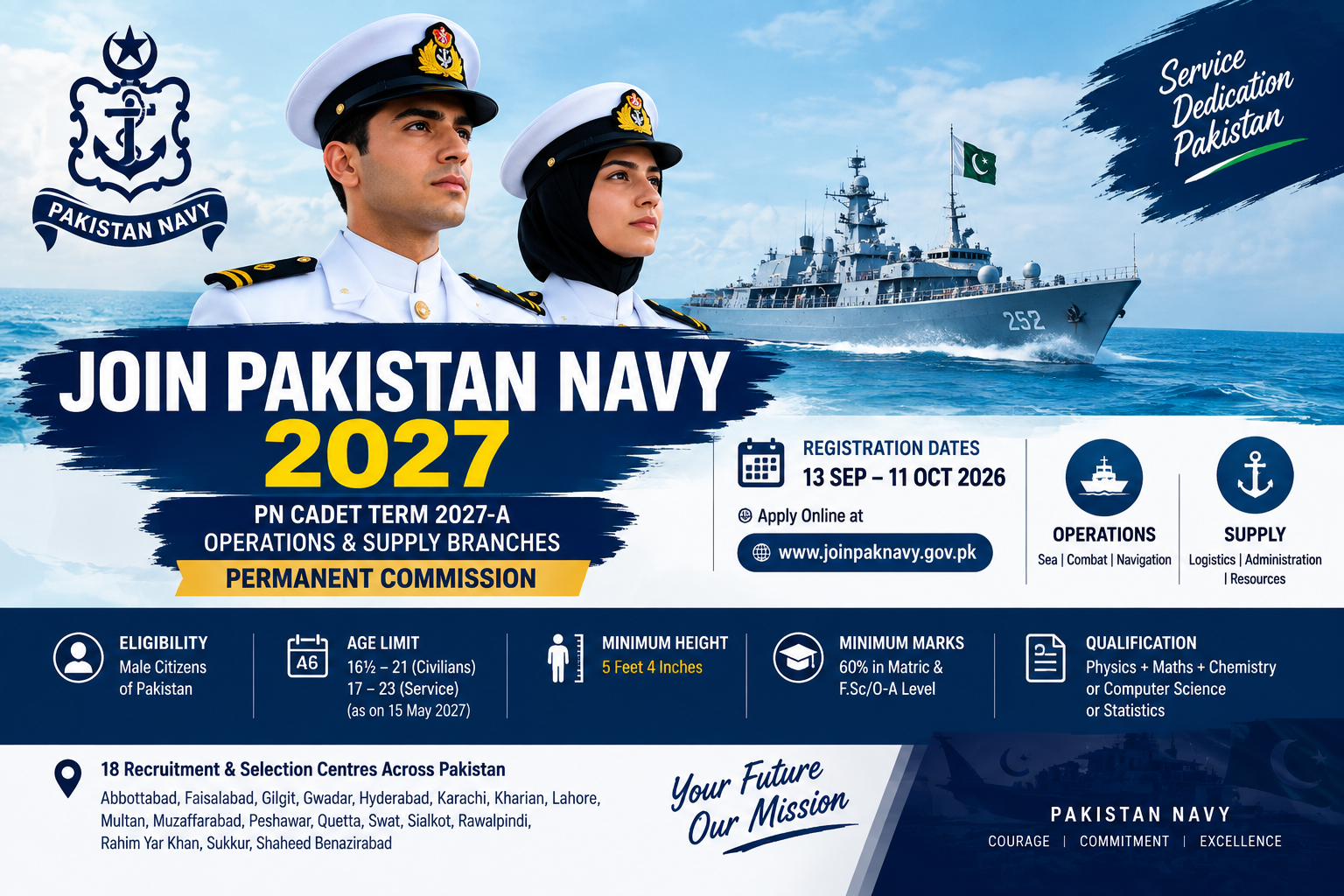
Join Pakistan Navy 2027 as a PN Cadet, and you’re not just applying for a job, you’re applying for a full military career path through Permanent Commission in either the Operations or Supply branch. Registration for Term 2027-A is open from 13 September 2026 to 11 October 2026, and this is one of those recruitment windows where the eligibility criteria are detailed enough that it’s genuinely worth reading through carefully rather than assuming you already know the requirements from a previous term’s advertisement or from what a friend told you about an older cycle.
Permanent Commission means this isn’t a short-term contract role. Once you’re commissioned as an officer through this route, you’re looking at a full naval career, not a fixed few years of service followed by a return to civilian life. That distinction matters, because it shapes everything else about how strict the eligibility bar tends to be, from age windows down to academic performance thresholds, and it’s worth keeping in mind throughout this entire article: every requirement here exists because the Navy is filtering for people it expects to serve, lead, and stay committed to a demanding profession for the long haul, not just for a few years.
Program Details
| Detail | Information |
| Recruiting Authority | Pakistan Navy |
| Entry Type | PN Cadet, Permanent Commission |
| Age (Civilians, Unmarried) | 16½ – 21 years, as on 15 May 2027 |
| Age (Service Candidates) | 17 – 23 years, as on 15 May 2027 |
| Minimum Height | 5 feet 4 inches |
| Minimum Marks Required | 60% in both Matric and F.Sc/O-A Level |
| Apply Online At | www.joinpaknavy.gov.pk |
👉 Register online at www.joinpaknavy.gov.pk between 13 September and 11 October 2026. If you need in-person guidance, visit your nearest Pakistan Navy Recruitment & Selection Centre — 18 cities are listed below.
Operations vs. Supply: Understanding the Two Branches
Before diving into eligibility, it’s worth understanding what you’re actually choosing between, since the advertisement offers entry into two distinct branches rather than a single generic officer track, and the difference between them is significant enough that it’s worth thinking through before you register rather than after.
The Operations branch is generally associated with the seagoing, combat, and navigational side of naval service, the officers who directly run ship operations, navigation, and combat systems at sea. Officers in this branch tend to spend a significant portion of their careers actually at sea, aboard ships, involved in the operational and tactical functions that most people picture when they think of naval service. It’s a branch built around direct command responsibility, technical systems operation, and the kind of high-pressure decision-making that comes with operating vessels and combat systems.
The Supply branch, by contrast, handles the logistics, administrative, and resource-management side of naval operations, the officers responsible for keeping the Navy’s supply chains, procurement, and administrative functions running smoothly. Without functioning logistics, no ship sails and no operation runs, so this branch, while less visibly “front-line” than Operations, carries genuine responsibility for the Navy’s ability to function at all. Officers here tend to work more with planning, resource allocation, and administrative systems than with the direct operational side of things.
Both are legitimate, respected officer career tracks within the Navy, but they involve meaningfully different day-to-day work once you’re commissioned, different skill sets get emphasized, and arguably different personality fits as well, someone who thrives on hands-on, high-pressure technical operation might lean toward Operations, while someone who’s naturally organized, detail-oriented, and drawn to logistics and planning might find Supply a better long-term fit.
The advertisement doesn’t specify whether you choose your branch at the point of registration or later in the selection process, so if this distinction matters significantly to your decision, and it probably should, it’s worth clarifying directly through the official portal or at your nearest Recruitment & Selection Centre before you register, rather than assuming you’ll be assigned a branch you’re equally happy with either way.
Who Is Eligible
Eligibility for PN Cadet Term 2027-A runs across several dimensions, citizenship, age, height, and academic performance, and each one needs to be satisfied independently. Falling short on any single criterion is enough to disqualify an otherwise strong candidate, so it’s worth checking each one against your own situation carefully rather than assuming you clear the bar overall just because you meet most of the requirements.
Citizenship and gender: This entry is open specifically to male citizens of Pakistan. There’s no ambiguity in the advertisement on this point, and no alternative eligibility route is mentioned for non-citizens or female candidates under this particular advertisement.
Age: This is where the criteria split into two distinct tracks, and it’s easy to misread if you skim past it quickly. If you’re a civilian candidate (unmarried), your age window is 16½ to 21 years, calculated as of 15 May 2027, not as of today’s date, not as of your registration date, and not as of whenever you happen to sit any test in the selection process. This is a specific, fixed reference date, and it’s worth doing the exact math on your own date of birth against 15 May 2027 rather than eyeballing it, since a candidate who’s a few weeks outside the window either way could be wrongly assuming eligibility (or wrongly assuming ineligibility).
If you’re a service candidate, meaning you’re already serving in the Armed Forces in uniform, the window is wider: 17 to 23 years, also as of 15 May 2027, and notably, this track is open to both married and unmarried candidates, unlike the civilian track which is restricted to unmarried applicants only. This distinction between civilian and service candidates is worth paying close attention to if you’re currently serving in any branch of the Armed Forces. You get both a wider age window (an extra two years at the upper end compared to civilians) and no marital status restriction, genuine advantages that don’t apply if you’re applying as a civilian candidate.
Height: The minimum height requirement is 5 feet 4 inches. The advertisement doesn’t list a separate chest measurement or other detailed physical standards beyond this height threshold in the poster itself, though it’s reasonable to expect that further physical and medical standards will be assessed later in the selection process, even if they’re not spelled out in this particular advertisement. If height is a borderline concern for you, it’s worth getting an accurate, professional measurement rather than relying on a rough self-estimate, since a fraction of an inch either way could matter at the eligibility screening stage.
Educational Qualification Requirements
This is the most detailed part of the advertisement, and it’s worth reading slowly, since there are several distinct pathways and exceptions built into the qualification criteria, and missing one of these nuances is probably the most common way an otherwise eligible candidate might mistakenly rule themselves out, or mistakenly assume they qualify when a specific condition actually applies to them.
The baseline requirement is that you must have passed both Matric and F.Sc (or O/A Level) with at least 60% marks, and your subject combination in F.Sc or A-Level needs to fall into one of three accepted combinations:
- Physics, Maths & Chemistry
- Physics, Maths & Computer Science
- Physics, Maths & Statistics
If your intermediate-level education doesn’t include one of these three specific subject combinations, this particular entry route likely isn’t open to you, regardless of how strong your marks are otherwise. Physics and Maths are common to all three accepted combinations, so if you’re missing either of those two subjects specifically, none of the three pathways will apply to you, and no amount of strength in your third subject will compensate for that gap. This is worth internalizing clearly: a student with excellent marks in, say, Biology, Chemistry, and English, without Physics and Maths, doesn’t qualify under any of the three listed combinations, no matter how strong their overall academic record is.
Special Provision for Pre-Medical Students
If you came from a Pre-Medical background rather than Pre-Engineering, you’re not automatically excluded, which is a meaningful accommodation given that Pre-Medical students typically study Biology, Chemistry, and Physics rather than Maths. The advertisement specifically allows Pre-Medical students to apply, provided they qualify in additional mathematics as part of their F.Sc or A-Level studies, and complete this requirement before 15 March 2027.
If you’re a Pre-Medical student considering this route, this is a genuinely important deadline to plan around, since it means arranging and completing additional maths coursework or examination well ahead of the main eligibility cut-off, not something you can leave until the last moment. Practically, this likely means enrolling in an additional maths course or private examination pathway well before early 2027, since most boards and institutions require lead time to register for and complete supplementary subject examinations. If this applies to you, it’s worth starting to research exactly how your specific board handles additional-subject registration as early as possible, ideally well before the September 2026 registration window even opens, so that by the time you register for the Navy’s own process, your additional maths pathway is already underway or confirmed.
Special Provision for O/A Level Candidates
If your qualification comes through the O-Level/A-Level system rather than Pakistan’s standard Matric/F.Sc system, you’re required to submit an IBCC (Inter Board Committee of Chairmen) equivalence certificate. This certificate translates your O/A Level results into the equivalent Pakistani grading and division system, and it’s a standard requirement across most Pakistani government and military recruitment processes for candidates with an international or O/A Level educational background, so this won’t be an unfamiliar requirement if you’ve applied to other Pakistani institutions or programs before.
If you don’t already have this certificate, it’s worth applying for it early, since IBCC processing can take time, particularly if your school or examination board needs to first verify and forward your results before IBCC can issue the equivalence document. You don’t want this document to become a bottleneck close to the registration deadline, especially given that the registration window itself is only about a month long.
Special Provision for F.Sc Appearing Candidates
If you’re currently in your final year of F.Sc and haven’t yet received your final result, you’re not automatically excluded from applying either, provided you meet a specific set of conditions, though this pathway carries more risk than the others and deserves careful thought before you rely on it.
You need at least 65% marks in Part-1 of your F.Sc, a slightly higher bar than the standard 60% overall requirement, since your Part-2 result isn’t yet available to average against, and the Navy is essentially using your stronger Part-1 performance as a proxy indicator of likely overall performance. You’re also required to provide a “hope certificate” from the head of your college or institute, essentially a formal statement confirming you’re expected to complete your qualification and are in good standing to do so. Alongside the hope certificate, you need to complete your F.Sc/HSSC or equivalent examination before 15 March 2027.
There’s an important consequence attached to this pathway worth understanding clearly before you rely on it: if you apply using a hope certificate and subsequently fail to achieve the required 60% overall marks once your final result is out, you will be disqualified at any stage of the selection process, or even discharged during training if this is discovered after you’ve already been commissioned and started training. This is a serious condition, not a minor administrative footnote tucked away in fine print you can safely ignore. If you’re applying on the strength of a hope certificate, make sure you have a realistic and confident expectation of clearing 60% overall, based on genuine self-assessment of your academic trajectory, before you commit significant time, and potentially months of selection-process involvement, to this pathway. Discovering a shortfall after you’ve already begun training would be a far more painful outcome than simply waiting for a future term if you’re not confident in clearing the threshold.
Registration Process and Timeline
Registration for Term 2027-A runs for almost a full month, from 13 September 2026 to 11 October 2026. Unlike some recruitment drives that leave the exact registration window vague or dependent on when an advertisement was published, this one gives you a clear, fixed start and end date, so there’s no ambiguity about your deadline the way there sometimes is with ads that simply say “within 15 days of publication.”
All registration is conducted through the official Pakistan Navy recruitment website: www.joinpaknavy.gov.pk. The advertisement doesn’t detail the exact online registration steps within the poster itself, so once you’re on the site, follow the guided registration process there, and make sure the personal, educational, and contact details you enter match your official documents exactly, since discrepancies between your application and your actual documents can create complications later in the process.
Given that this is a month-long window rather than a tight few-day deadline, there’s less pressure to rush your application in the first few days, but it’s still worth avoiding the temptation to leave registration until the very final days of the window, in case of any last-minute technical issues with the portal or documentation you discover you’re still missing. A portal experiencing high traffic in its final 48 hours is a genuinely common occurrence across government recruitment systems in Pakistan, so registering with some buffer time before 11 October gives you room to troubleshoot if something doesn’t go smoothly on your first attempt.
Staying Connected Through Official Channels
Beyond the main website, Pakistan Navy maintains official presence on social platforms specifically for recruitment updates: Facebook under “Pakistan Navy Recruitment online” and X (formerly Twitter) at @pnrectt. If you want to stay updated on any changes, clarifications, or additional announcements related to Term 2027-A beyond what’s in this advertisement, these official channels are the places to follow, rather than relying on unofficial forwards, screenshots circulating in WhatsApp groups, or third-party job pages that might carry outdated or inaccurate information about deadlines or requirements.
Recruitment & Selection Centres Across Pakistan
If you have questions that aren’t answered by the website, or you’d prefer in-person guidance through the registration and eligibility process, Pakistan Navy maintains Recruitment & Selection Centres in the following 18 cities, spread across every province and region of the country:
Abbottabad, Faisalabad, Gilgit, Gwadar, Hyderabad, Karachi, Kharian, Lahore, Multan, Muzaffarabad, Peshawar, Quetta, Swat, Sialkot, Rawalpindi, Rahim Yar Khan, Sukkur, and Shaheed Benazirabad.
This is a genuinely wide geographic spread, covering major cities as well as more regionally distributed centres like Gilgit, Muzaffarabad, Swat, and Gwadar, which means most candidates across Pakistan should have a Recruitment & Selection Centre within reasonable reach, rather than needing to travel to a single centralized location for basic queries or guidance. If you’re based somewhere without an obvious nearby centre, it’s worth checking the official website for the exact address and contact details of your nearest one before making a trip, since walking in without confirming hours or exact location wastes time you could spend on other parts of your preparation.
Why the Eligibility Bar Is Structured This Way
It’s worth understanding, even briefly, why a Permanent Commission cadet entry carries this level of detail in its eligibility criteria compared to a typical civilian government job advertisement. Because this is a career-length military commitment rather than a fixed-term contract, and because commissioned officers go on to hold command and leadership responsibilities, the selection process is designed to filter carefully at the entry point, academically, physically, and in terms of long-term commitment, rather than relying on probation periods or performance reviews to weed out unsuitable candidates after the fact, the way many civilian government roles do.
This is also likely why the qualification requirements are unusually specific about subject combinations (Physics, Maths, and one of Chemistry/Computer Science/Statistics) rather than accepting any general science background. Operations and Supply branch roles both depend heavily on quantitative and technical reasoning, whether that’s navigation and systems work in Operations or logistics and resource planning in Supply, and the subject requirements reflect that underlying technical demand rather than being an arbitrary administrative preference.
What to Expect Beyond This Advertisement
This particular poster focuses on eligibility criteria, qualification requirements, and registration dates, but it doesn’t detail the full selection process that follows registration. Based on how Pakistan Navy cadet entries have historically worked, candidates who register and meet the initial eligibility screening can typically expect to go through further stages such as a written test, an ISSB (Inter Services Selection Board) assessment, and a medical examination, though this specific advertisement itself doesn’t spell out those exact stages for Term 2027-A. Treat this as general background context rather than confirmed detail for this particular term, and rely on the official portal or your nearest Recruitment & Selection Centre for the authoritative, current breakdown of what happens after you register.

Given that a multi-stage selection process is standard for this kind of officer entry, it’s worth pacing your preparation accordingly rather than assuming registration itself is the main hurdle. Academic qualification gets you eligible to register, but the stages that typically follow tend to assess a broader range of qualities, physical fitness, psychological aptitude, teamwork, and interview performance among them, so treating the registration window as your only deadline to prepare for would likely leave you underprepared for what comes next. Candidates who start thinking about physical fitness and general aptitude preparation during the registration window itself, rather than waiting for a call letter to prompt them into action, tend to be in a stronger position once the substantive selection stages begin.
Documents Worth Preparing in Advance
While the advertisement doesn’t provide a document checklist within the poster itself, based on standard practice for this kind of officer recruitment, it’s reasonable to expect you’ll eventually need your CNIC or B-Form, your Matric and F.Sc/O-A Level certificates and detailed marksheets, recent photographs, and, where applicable, your IBCC equivalence certificate or hope certificate as discussed above. If you’re a service candidate, you’ll also likely need documentation confirming your current service status and any required clearance from your existing command, since applying while serving typically requires your chain of command to be aware of and permit the application.
Getting a head start on organizing these documents during the registration window, rather than waiting until a later stage of selection asks for them, is a sensible way to avoid last-minute scrambling. Certificates that need attestation or equivalence processing, in particular, are worth starting early, since these can take longer to obtain than expected, and a document delay at a later selection stage can cost you the whole cycle even if you’ve already cleared earlier stages successfully.
Weighing This Opportunity Seriously
A few practical questions are worth sitting with honestly before you commit to registering. Are you genuinely prepared for the physical and academic demands of officer training, not just the entry-level eligibility bar on paper? Is a long-term, structured military career something you’re pursuing because it genuinely fits your goals and temperament, rather than because it’s the most visible or well-known opportunity currently in front of you? And if you fall into one of the special-provision categories, Pre-Medical background or F.Sc still in progress, do you have a realistic, confident path to meeting the additional conditions attached to your specific pathway by 15 March 2027, or are you hoping things will work out without a concrete plan?
None of these questions have a universally right answer, and only you can answer them honestly for your own situation, but working through them now, before you invest time in registration and the stages that follow, tends to serve candidates far better than discovering the answers partway through a selection process that can span several months and involve real financial and time costs for travel, testing, and preparation.
Who is eligible to apply for PN Cadet Term 2027-A?
Male citizens of Pakistan meeting the age, height, and educational qualification criteria detailed above.
What is the age limit for service candidates?
17 to 23 years, as on 15 May 2027, and both married and unmarried service candidates are eligible.
What is the minimum height requirement?
5 feet 4 inches.
What marks do I need in Matric and F.Sc/O-A Level?
At least 60% in both, with your F.Sc/A-Level subject combination being one of: Physics-Maths-Chemistry, Physics-Maths-Computer Science, or Physics-Maths-Statistics.
I’m still waiting on my F.Sc final result. Can I still apply?
Yes, if you have at least 65% marks in Part-1, provide a hope certificate from your college/institute head, and complete your F.Sc/HSSC or equivalent exam before 15 March 2027. Note that failing to reach 60% overall after this can result in disqualification or discharge even during training.
Where can I get in-person help with my application?
t any Pakistan Navy Recruitment & Selection Centre, located in Abbottabad, Faisalabad, Gilgit, Gwadar, Hyderabad, Karachi, Kharian, Lahore, Multan, Muzaffarabad, Peshawar, Quetta, Swat, Sialkot, Rawalpindi, Rahim Yar Khan, Sukkur, and Shaheed Benazirabad.
Is this a short-term contract or a full career commitment?
Permanent Commission means this is a full naval career path, not a fixed-term or contractual role. It’s worth treating this as a long-term life decision rather than a temporary job application.
Leave a Reply